
Franz von Stuck
1863 Tettenweis – 1928 Munich
Short information about the artist
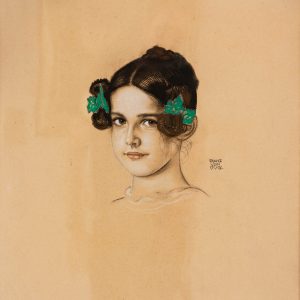
The ‘Prince of Painters’ from Munich epitomises an era in which academic tradition and Symbolist renewal overlapped. His large-scale mythological works, such as *Sin*, brought him international renown, whilst the more intimate portraits of his daughter Mary – for example, those featuring her characteristic green bows – demonstrate how he translated personal relationships into aesthetic form. Villa Stuck, a total work of art designed by the artist himself, exemplifies his ambition to fuse painting, architecture and the decorative arts into a single entity.
More information about the artist
The ‘Prince of Painters’ from Munich epitomises an era in which academic tradition and Symbolist renewal overlapped. His large-scale mythological works, such as *Sin*, brought him international renown, whilst the more intimate portraits of his daughter Mary – for example, those featuring her characteristic green bows – demonstrate how he translated personal relationships into aesthetic form. Villa Stuck, a total work of art designed by the artist himself, exemplifies his ambition to fuse painting, architecture and the decorative arts into a single entity.
Biography of a Munich ‘prince of painters’
Franz Ritter von Stuck was born on 23 February 1863 in Tettenweis, a small village in the district of Passau in Lower Bavaria. His background as the son of a Catholic farming and milling family set him apart from other artists of the Munich fin de siècle, who often came from educated middle-class or affluent backgrounds. His talent for drawing was evident even in childhood, initially manifesting itself in caricatures of villagers. This early engagement with human physiognomy laid the foundation for his later portraiture, which oscillates between representational depiction and intimate observation. His artistic training began at the Royal School of Arts and Crafts in Munich, which he attended from 1878 to 1881. There, he was taught not only technical craftsmanship but also an appreciation of decorative and applied arts, which would later become central to his concept of the Gesamtkunstwerk. From 1881 to 1885, Stuck continued his studies at the Royal Academy of Fine Arts in Munich, where he honed his skills in painting and composition. This dual training – in the arts and crafts and in the academic tradition – had a lasting influence on his artistic approach and set him apart from the purely historical painters of his time.
Breakthrough and establishing oneself in the art world
Even whilst still a student, Stuck made a name for himself as a prolific draughtsman and designer. From 1882, he worked for the Viennese publishing house Gerlach & Schenk, alongside artists such as Max Klinger and Gustav Klimt, producing designs for allegorical works and emblems. This work brought him his first nationwide recognition and sharpened his instinct for condensed, symbolic visual motifs. At the same time, between 1887 and 1892, he worked as a caricaturist for the Munich magazine *Fliegende Blätter*, which honed his ability for ironic exaggeration as well as for precise character studies. Franz von Stuck achieved his public breakthrough in 1889 with the painting *Guardian of Paradise*, which was awarded a gold medal at the exhibition in Munich’s Glaspalast. The work earned him prize money of 60,000 marks – a considerable sum for the time, which secured his financial independence and social status. Shortly afterwards, he became a key figure in Munich’s art scene. In 1892, he co-founded the Munich Secession, which deliberately opposed conservative artistic circles and sought new approaches to exhibition practice as well as a greater openness to international movements. Despite this secessionist stance, Stuck is frequently grouped alongside Franz von Lenbach and Friedrich August von Kaulbach among the so-called ‘princes of painting’. This term refers to those artists who were regarded as particularly prominent due to their social status, their prestigious studios and their close ties to an aristocratic and upper-middle-class clientele. In fact, stylistically, Stuck represented the antithesis of Lenbach, particularly in the debate over artistic renewal and modern trends. Whilst Lenbach remained committed to the traditional representational portrait, Stuck turned to Symbolism and Art Nouveau.
Symbolism, Art Nouveau and mythological iconography
Stylistically, Franz von Stuck’s work can be situated at the intersection of Symbolism and Art Nouveau. His compositions combine decorative, linear rhythms and an ornamental approach to the organisation of space with allegorical and mythological themes. Among the key works of this phase is the 1893 painting ‘Sin’, which brought him international acclaim and earned him a medal at the World’s Fair in Chicago. The painting depicts a femme fatale with a snake, who appears both seductive and menacing – a representation that exemplifies Stuck’s fascination with the demonic, the mythological and the erotic. In other works such as *Salome*, *Luzifer* and *Der Krieg*, Stuck also developed an iconographic language that combined ancient mythology with modern psychological interpretations. His paintings are often rendered in dark, glowing hues, creating an atmospheric tension. This painterly approach, combined with precise draughtsmanship, made him one of the most influential figures of German Symbolism. He also worked for the art magazines *PAN* and *Jugend*, which played a key role in the spread of Art Nouveau throughout the German-speaking world. In 1895, Stuck was appointed professor at the Academy of Fine Arts in Munich. His painting class was later attended by such prominent artists as Paul Klee, Wassily Kandinsky and Josef Albers. This teaching role underscores Stuck’s position as a bridge between the late 19th century and the avant-garde art of early modernism. Although his own work remained stylistically rooted in Symbolism, he taught his pupils the technical fundamentals and an understanding of compositional rigour that could also be put to good use in abstract works.
Villa Stuck as a total work of art
A key project in Franz von Stuck’s career was the construction of his villa on Prinzregentenstraße in Munich, which was built between 1897 and 1898. Villa Stuck is a Gesamtkunstwerk in the truest sense of the word: Stuck designed not only the architecture, but also the interior décor, furniture, picture frames and even individual decorative elements. The house combines classical models – in particular Pompeian and Roman architecture – with elements of Art Nouveau and Symbolism. The sculpture garden features works such as the ‘Amazon’ and the ‘Athlete’, which demonstrate Stuck’s interest in the interplay between painting, sculpture and architecture. The villa served as a home, a studio and a venue for social engagements. It was here that Stuck received collectors, critics and fellow artists, and it was here that many of his most significant works were created. Today, the building houses the Villa Stuck Museum, which showcases both the original rooms and temporary exhibitions on art from around 1900. The villa is a key example of the concept of the ‘Gesamtkunstwerk’ (total work of art), which was championed by Richard Wagner in the late 19th century and taken up by numerous artists working in various media.
Late works and posthumous legacy
In the years following 1913, Stuck continued his work as a painter, sculptor and architect, whilst his style remained largely consistent. In 1906, he was ennobled and from then on bore the title ‘Knight von Stuck’, which further cemented his social status. He died on 30 August 1928 in Munich. His work was received in varying ways in the years that followed: during the Nazi era, he was to some extent co-opted, whilst in the post-war period he was regarded by many as an outdated figure of historicism. It is only in recent decades that scholars have reassessed his work and highlighted his significance for the development of modernism. In particular, the fact that artists such as Kandinsky and Klee studied under him points to an indirect yet powerful link between Symbolism and abstract art. Furthermore, the concept of the ‘Gesamtkunstwerk’ (total work of art), which Stuck realised at Villa Stuck, embodies a vision of art that extends far beyond the individual painting and seeks to permeate architecture, design and everyday life – an approach that continues to have an impact on contemporary art to this day.
Significance for collectors and art historians
For art-loving collectors and scholars, Franz von Stuck’s works are of particular interest because they represent an era in which traditional academic painting and modern trends overlapped. The large-scale mythological works such as ‘Sin’ or ‘Lucifer’ are iconic examples of Symbolism, whilst the smaller portraits – particularly those of his daughter Mary – offer insights into the private life of an artist who consistently shaped his life in an aesthetic manner. A key tool for classifying and evaluating Stuck’s works is the catalogue raisonné, which systematically records his paintings, drawings and sculptures. This catalogue is indispensable for determining the authenticity and dating of his works. The painting technique – often oil on canvas, sometimes combined with a gold ground or decorative elements – is characteristic of Stuck’s aim to combine painterly quality with ornamental appeal.