

Ernst Ludwig Kirchner
1880 Aschaffenburg – 1938 Frauenkirch-Wildboden
Purchase: If you would like to offer us a work of art by Ernst Ludwig Kirchner, please send us a photo to info@galerie-paffrath.deWe will advise you on the selling price and in the event of a successful sale we will charge a commission of 10 %, including all costs. Alternatively, we will purchase your artwork directly against immediate payment.
Short information about the artist
During his time as a student in Dresden, Ernst Ludwig Kirchner met Fritz Bleyl, Erich Heckel and Karl Schmidt-Rottluff and began working with them artistically. The four friends founded the artists’ association “Die Brücke” in 1905 – with the aim of “drawing together all revolutionary and fermenting forces” (Schmidt-Rottluff). The big city offered Ernst Ludwig Kirchner a wealth of new motifs, which Kirchner translated into simplified, sharply contoured forms, expressive features and garish colour contrasts. These cityscapes are incunabula of Expressionism. They make Kirchner one of the most important German artists of the 20th century. The outbreak of the First World War marked a turning point in Kirchner’s life. The events of the war and his military service plunged the artist into existential fear. They ultimately led to illness and long stays in a sanatorium. His artistic production during this time is therefore all the more remarkable. Ernst Ludwig Kirchner settled in Frauenkirch near Davos in 1917. His big city paintings are now followed by mountain landscapes and depictions of rural life. Kirchner lived and worked here until his suicide in 1938.

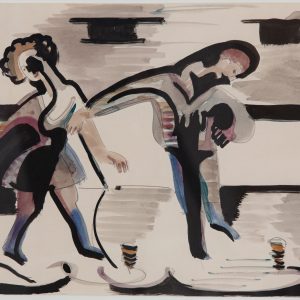
More information about the artist
During his time as a student in Dresden, Ernst Ludwig Kirchner met Fritz Bleyl, Erich Heckel and Karl Schmidt-Rottluff and began working with them artistically. The four friends founded the artists’ association “Die Brücke” in 1905 – with the aim of “drawing together all revolutionary and fermenting forces” (Schmidt-Rottluff). The big city offered Ernst Ludwig Kirchner a wealth of new motifs, which Kirchner translated into simplified, sharply contoured forms, expressive features and garish colour contrasts. These cityscapes are incunabula of Expressionism. They make Kirchner one of the most important German artists of the 20th century. The outbreak of the First World War marked a turning point in Kirchner’s life. The events of the war and his military service plunged the artist into existential fear. They ultimately led to illness and long stays in a sanatorium. His artistic production during this time is therefore all the more remarkable. Ernst Ludwig Kirchner settled in Frauenkirch near Davos in 1917. His big city paintings are now followed by mountain landscapes and depictions of rural life. Kirchner lived and worked here until his suicide in 1938.