
Lotte Laserstein
1898 East Prussia – 1993 Kalmar
Short information about the artist
Lotte Laserstein is now regarded as one of the most significant rediscoveries of German modernism – yet until the 1980s, her name had been all but forgotten. As a master student at the Prussian Academy, she was one of the first women artists to be admitted on a regular basis and, with works such as ‘Evening over Potsdam’, helped shape the image of the ‘New Woman’ of the Weimar Republic. Her close collaboration with Traute Rose produced iconic works of psychologically nuanced portraiture.
More information about the artist
Lotte Laserstein is now regarded as one of the most significant rediscoveries of German modernism – yet until the 1980s, her name had been all but forgotten. As a master student at the Prussian Academy, she was one of the first women artists to be admitted on a regular basis and, with works such as ‘Evening over Potsdam’, helped shape the image of the ‘New Woman’ of the Weimar Republic. Her close collaboration with Traute Rose produced iconic works of psychologically nuanced portraiture.
Lotte Laserstein and the rediscovery of New Objectivity
Lotte Laserstein is one of the most significant rediscoveries in 20th-century German painting. Her name epitomises not only the artistic possibilities of the Weimar Republic, but also the violent rupture that National Socialism left in the lives of so many artists. As a painter of the New Objectivity movement, she combined a precise, almost sober power of observation with psychological depth and a subtle sensitivity for depicting modern ways of life. Her portraits, nudes and figurative scenes – whether in oil on canvas or as watercolours and drawings – reveal a combination of technical mastery and empathetic closeness to her models that continues to fascinate to this day. Born on 28 November 1898 in Preußisch Holland – now Pasłęk in Poland – Lotte Laserstein grew up in an educated middle-class family. Her father, Hugo Laserstein, was a chemist and died at an early age. Her mother, Meta (née Birnbaum), came from a Jewish family, a fact that later led to Laserstein being stigmatised as a ‘three-quarters Jew’ under Nazi racial policies. Following her father’s death in 1902, the family moved to Danzig, where Lotte grew up with her sister Käte, living with her grandmother Ida Birnbaum and her aunt Elsa Birnbaum – herself a working painter. This family influence, shaped by a woman active in the arts, laid the foundation early on for Laserstein’s own self-image as an artist.
Academic education and early successes in Berlin
As early as 1909, Laserstein began receiving systematic art tuition at her aunt’s art school in Danzig. This early, professional guidance was exceptional for a girl of her time and explains the technical confidence that characterises her later works on paper and canvas. In 1912, the family moved to Berlin, where Lotte attended the Chamisso School – a secondary school for girls which was one of the few to offer a leaving certificate qualifying for university entry. After passing her A-levels in 1918, she enrolled at the Friedrich-Wilhelms-Universität in Berlin to study philosophy and art history; at the same time, she attended a school for commercial art and supplemented her education between 1920 and 1921 with private lessons from the Berlin painter Leo von König. Her studies at the Berlin University of the Arts, then known as the Prussian Academy of Arts, from 1921 onwards had a particularly formative influence on her. Laserstein was one of the first women to be admitted as a full student there – an achievement of which she remained proud throughout her life. She studied under the renowned portrait painter and professor Erich Wolfsfeld and graduated in 1927 as a master student. This academic training honed her ability to depict figures with precision and to work from the live model, a practice that remained central to her entire body of work. As early as the late 1920s, Laserstein had made a name for herself in the Berlin art scene. She exhibited at the Association of Berlin Women Artists, an important forum for women in the arts, and gained public recognition for her realistic, psychologically nuanced portraits and group portraits. Among her best-known works from this period are ‘Im Gasthaus’ (1927), which depicts a group of young people in a contemporary interior, as well as ‘Russian Girl with Powder Box’ (1928) and ‘Morning Toilette’ (1930). These paintings combine the objective observational style of New Objectivity with a warm, almost intimate colour palette and expressive lighting, which set Laserstein apart from many of her contemporaries.
Traute Rose and the motif of the ‘New Woman’
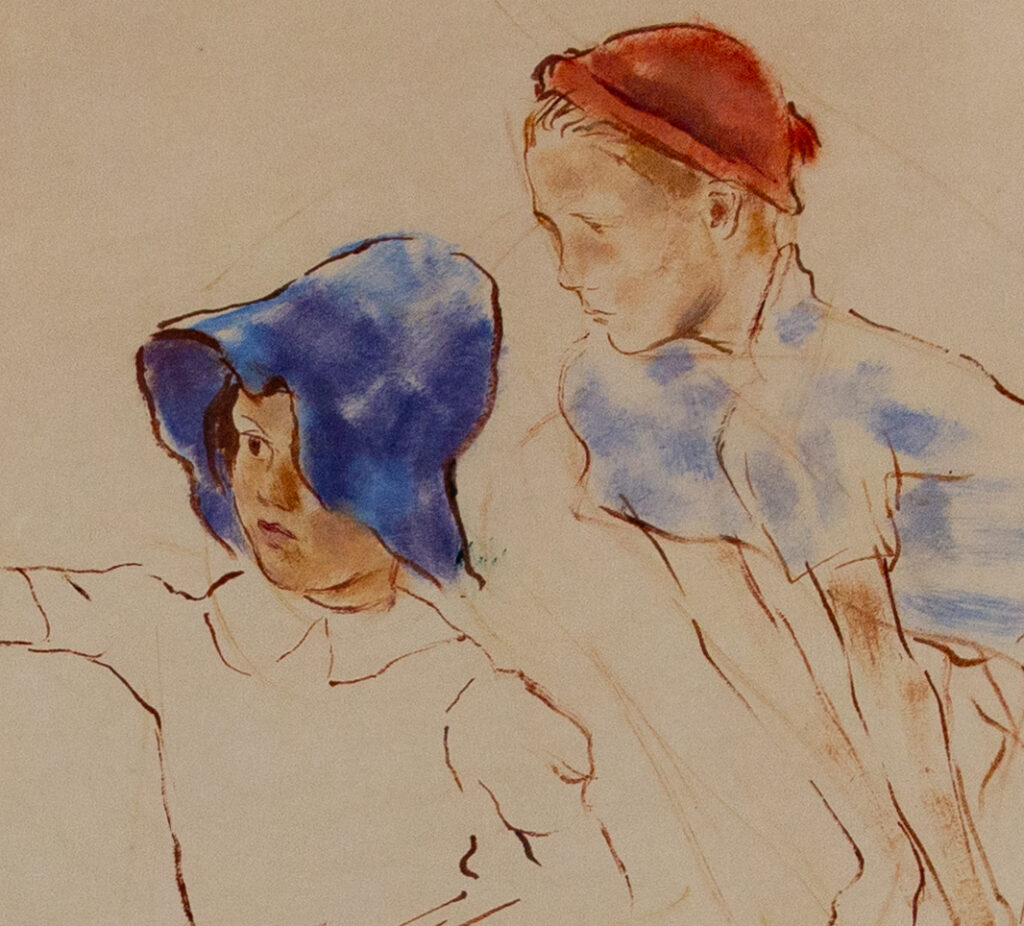
Central to understanding Laserstein’s work in the 1920s is her close artistic collaboration with Traute Rose, her pupil, partner and most important model. Rose appears in numerous paintings and drawings, often in modern, androgynous depictions that embody the image of the emancipated ‘New Woman’ of the Weimar Republic. In works such as ‘Evening over Potsdam’ (1930) or ‘Young Painter’ (1929), also known as ‘Studio’, Laserstein depicts Rose in poses that challenge traditional gender roles: active, self-assured, urban. These works are of great art-historical value because they are not only formally compelling but also provide a precise historical record of a brief era of cultural openness in Germany. Laserstein’s painting technique was characterised by meticulous preparatory sketches, clear compositional structures and a subtle yet expressive use of colour. This combination of draughtsmanlike precision and painterly sensitivity is also evident in her watercolours and pastels – an often underestimated part of her oeuvre. Such works on paper, including depictions of children and young people rendered with sparing use of watercolour and elegant linework, add an intimate, empathetic dimension to the artist’s body of work.
Persecution, exile and a new beginning in Sweden
When the National Socialists came to power in 1933, Laserstein’s life changed radically. Because of her Jewish heritage, she was effectively barred from practising her profession; her works were removed from exhibitions, and she received no public commissions. In 1937, she followed Traute Rose into exile in Sweden and settled in Kalmar, a small town on the Baltic coast. The move meant the loss of her Berlin studio network, her clientele and her artistic public profile. During the Second World War, Laserstein kept her head above water with odd jobs and portrait commissions, but often had to put her artistic ambitions on hold. After the war, she resumed her painting, continuing to work in a realistic and figurative style, yet the art-historical context had changed fundamentally. The post-war avant-garde was oriented towards abstraction and Art Informel; many regarded Laserstein’s realism as outdated. Furthermore, as an exile in Sweden, she remained largely isolated and was long forgotten in Germany. It was not until the 1980s that a cautious rediscovery began, driven by feminist art history and a growing interest in persecuted female artists of the modern era. In 1987, she became a Swedish citizen, but remained in Kalmar until her death on 21 January 1993.
Rediscovery and a new art-historical assessment
Since the early 2000s, interest in Lotte Laserstein has grown considerably. Major exhibitions at the Berlinische Galerie, the Städel Museum in Frankfurt and the Moderna Museet in Sweden have brought her work to the attention of a wider audience. Anna-Carola Krausse has published a scholarly catalogue raisonné, which forms the basis for a well-founded art-historical assessment. Laserstein is now recognised as a key representative of the verist strand of New Objectivity, particularly for her nuanced portraiture and her depiction of modern, urban life in the Weimar Republic. Her drawings and watercolours are also attracting increasing attention. Works such as ‘Boy with a Kasper Puppet (Wolfgang Karger)’ or ‘Two Boys with an Oil Lamp’ demonstrate that Laserstein maintained her characteristic blend of empathetic observation and technical mastery even in small formats and on paper. Drawings of children and young people, such as a possible depiction of two boys rendered with sparing use of watercolour, fit seamlessly into this body of drawings. They reveal the intimate perspective on human interaction and everyday moments that runs through Laserstein’s entire body of work. This reassessment in art history has also had an impact on perceptions within the art market. Laserstein’s paintings and watercolours from his time in Berlin are now regarded as important testimonies to a bygone era and are attracting corresponding attention from collectors, museums and research institutions. Clear attribution, provenance research and the scholarly documentation of his works are decisive factors in determining their art-historical value and enduring significance.